
Trans-Caspian International Transport Route: Current Trends and Cargo-Generating Regions
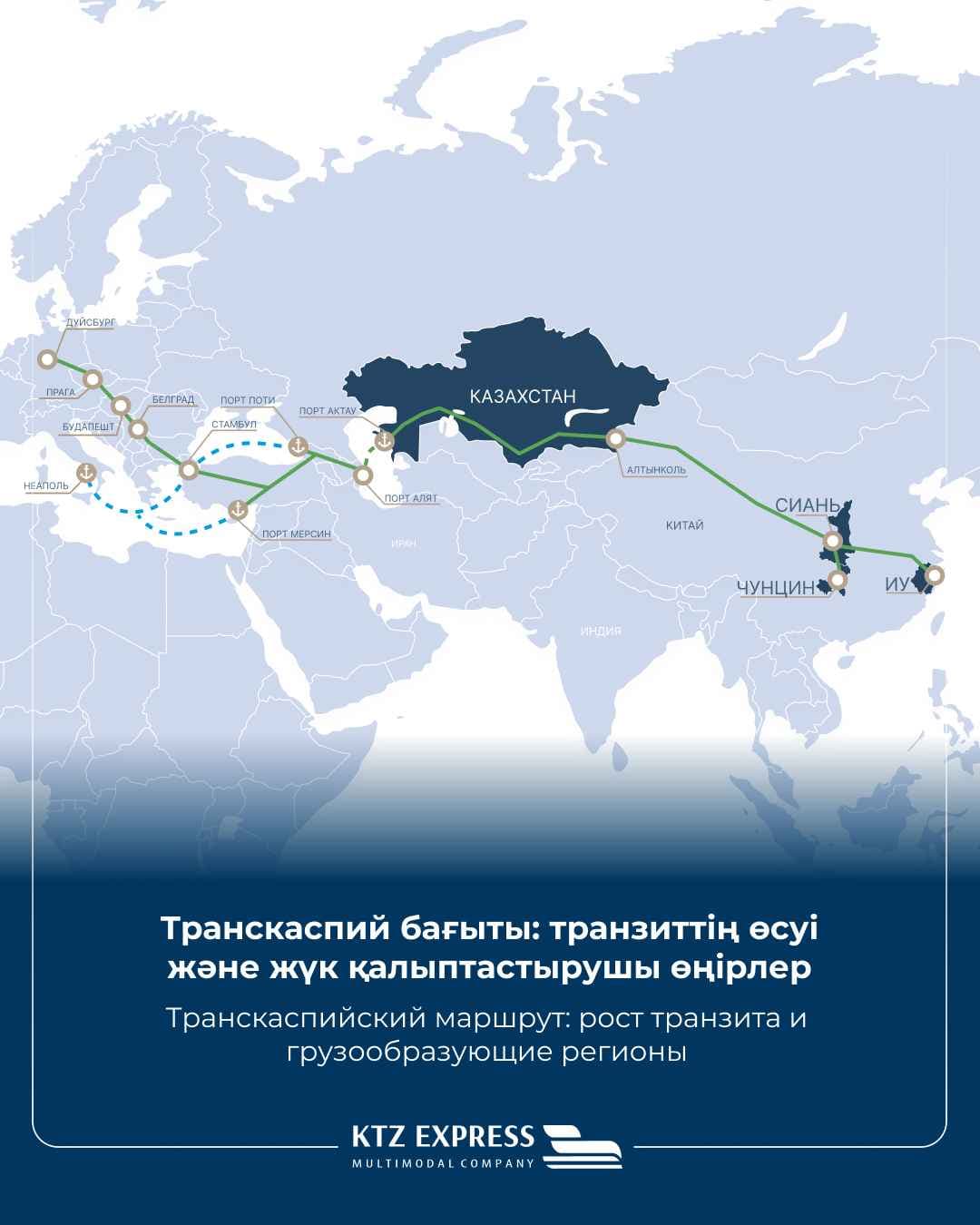
Trans-Caspian International Transport Route: Current Trends and Cargo-Generating Regions
Today the Trans‑Caspian International Transport Route (TITR), known as the “Middle Corridor”, is becoming a pivotal link in logistics between Asia and Europe, offering an effective alternative to traditional maritime routes. Over recent years, the corridor has established itself as one of the key transit arteries connecting China, Central Asia, the Caspian region, the Caucasus and Europe. Its development has become particularly relevant in view of global shifts in logistics and a growing demand for diversification of trade routes.
At the heart of this success lies the dynamically growing freight flows from China and the infrastructure development measures in which KTZ Express plays a crucial role.
Today the corridor is demonstrating stable growth in transportation metrics. In 2024, 358 container trains originating from the People’s Republic of China travelled via the route — 33 times more than in 2023 — a historic record for the corridor. For the first nine months of 2025, 262 container trains were dispatched east-to-west, 15 % above the same period in 2024.
The potential of the Middle Corridor is far from exhausted. According to estimates, with infrastructural bottlenecks eliminated and coordinated policy continued, transit flows could reach 283 000 TEU, equivalent to roughly 3 000 container trains. Experts emphasise that demand for alternative Eurasian routes will remain at a high level—opening new opportunities for all corridor participants.
Achieving these ambitious goals is supported by comprehensive work with partners: together with railway administrations of China, Azerbaijan, Georgia and Turkey a unified tariff policy is forming, bottlenecks are being synchronously eliminated, digital solutions are being introduced and customs procedures optimised. Special attention is paid to shortening delivery times. Today the average transit time from China to Europe via the corridor is 25 days, compared to previously 35-40 days and 45-60 days by sea – almost twice as long. All of this is transforming the Trans-Caspian route into a modern, competitive and sustainable transport corridor linking East and West.
Development of the corridor is underpinned by large-scale infrastructure projects of the group of companies of АО НК «Қазақстан темір жолы» that form a full continental bridge connecting China, Central Asia, the Caucasus and Europe: the dry port Khorgos Gateway, the Terminal GTS-2 in Almaty, the Container hub at the Port of Aktau and others. These projects not only increase the route’s throughput capacity but also strengthen Kazakhstan’s position as a reliable transport hub of the Eurasian continent.
Investments in infrastructure create the basis for growth, while the main share of transit freight flows via the corridor is ensured by Chinese regions — export-driving, high-tech, industrial and consumer-focused. Let us examine in more detail which provinces and cities play a key role in forming transit flows via the corridor.
Xi’an — the undisputed leader. The capital of Shaanxi Province has in recent years travelled from a historic centre of the Silk Road to one of China’s largest logistics hubs. Today Xi’an is not only an industrial giant but the principal consolidation point for goods travelling along the Middle Corridor. In the first nine months of 2025, nearly 47 % of all dispatches from China via the corridor originated in Xi’an. Its leadership is underpinned by three factors: strategic location enabling formation of more than 30 % of all container trains to Europe; a new Sino-Kazakh terminal launched in 2024 which triggered a 33-fold increase in dispatches; and a strong industrial base covering electric vehicles, electronics and solar panels from brands such as BYD, Geely, Chery and Hongqi.
Yiwu — the world’s wholesale super-market. The city, rightly dubbed the “heart of global light-industry trade”, hosts the world’s largest trade complex — Yiwu International Trade City — with tens of thousands of trading units and millions of product types. In January–September 2025 Yiwu formed 10 % of all cargo via the corridor. These are everyday demand goods: stationery, fashion-jewellery, electronics, toys, textiles. The scale is impressive: 2.1 million m² of trading area (equivalent to 300 football fields), 75 000 trading points and export to over 200 countries and regions. Yiwu is, in effect, a global factory for light-wholesale that sets the pace for international container freight.
Chongqing — an industrial giant. As a municipality under central control and the largest industrial hub in southwest China, its specialisation lies in automobiles, electronics and machinery. Several facts underline its weight: more than 100 million vehicles have been produced there; 95 % of laptops exported from Chongqing go to the world market; in 2024 the municipal government dispatched more than 350 container trains via the China-Europe route. The region accounts for about 7 % of cargo via the corridor but its importance is growing, especially as a logistics hub for China’s interior regions.
New players. 2025 marks the year of geographical expansion: new regions have joined the corridor — Wuhan, Shenzhen and Tuanzecun. This strengthens diversification of flows and confirms that the corridor is becoming an increasingly demanded tool for many provinces of China.
Thus the Middle Corridor turns into not just a route but a living system where each link — from Xi’an to Yiwu and from Yiwu to Chongqing — plays a key role in strengthening the connections between China, Central Asia, the Caucasus and Europe.
KTZ Express is the key transit operator on the territory of Kazakhstan for the route, playing a decisive role in the corridor’s development. The company has offices in the Chinese port of Lianyungang, Xi’an, as well as in Hong Kong, Turkey, Hungary and Russia. A broad network of subsidiaries and partners, established cooperation with leading Chinese logistics firms and participation in the infrastructure development along the corridor allow KTZ Express to provide highly efficient transport solutions to clients. This approach strengthens the company’s position as one of the most reliable and professional operators in the Eurasian transit space.